Oracle Forms Support
Overview
Rapise Oracle Forms Library enables recording, learning, and playback of various Oracle Forms controls.
Supported Oracle Forms Versions
Rapise supports Oracle Forms versions 10 and higher.
Supported Java Versions
Integration works with Java versions 5 and higher. If you launch Oracle Forms from a browser using .jnlp files, this requires Java Web Start. In most cases, this means you are using the legacy JRE 1.8, as Java Web Start was removed from Java 11 and later versions.
What Needs to be Configured
To enable Rapise integration with Oracle Forms, configuration changes are required in two places:
-
Client-side (Java environment): The Java Control Panel or environment variables must be configured to load the Rapise Java Bridge agent. This is covered in the Preparing Java Environment section below.
-
Server-side (EBS/Oracle Forms): The Oracle Forms application URL must include the
record=namesparameter. This can be configured at the system level by an EBS administrator or in individual.jnlpfiles. See the Launching Oracle Forms Application section for details.
Preparing Java Environment
There are two ways of configuring Java environment: through Java Control Panel and through Command Line options.
1. Java Control Panel
Run Java Control Panel:
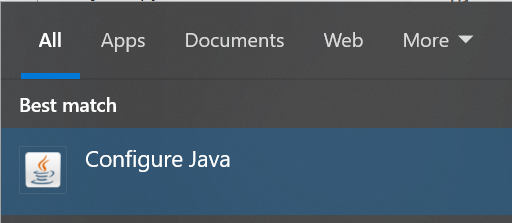
Go to Java > View > Runtime Parameters
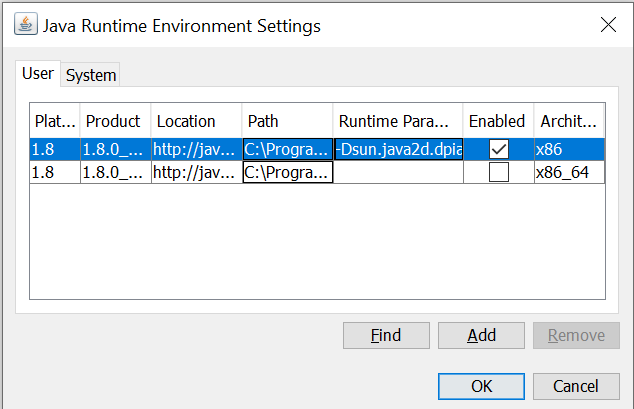
Runtime Parameters value to:
-Dsun.java2d.dpiaware=true -Dsun.java2d.uiScale=1.0 -javaagent:C:\PROGRA~2\Inflectra\Rapise\Extensions\JavaWrapper\Agents\PreMainAgent.jar
-Djava.security.policy=C:\PROGRA~2\Inflectra\Rapise\Extensions\JavaWrapper\Agents\file.policy -Djavax.accessibility.assistive_technologies=com.smartesoft.smartestudio.accessibility.AccessBridge
2. _JAVA_OPTIONS or JAVA_TOOL_OPTIONS
You can also configure the Java environment by setting environment variables. There are two options:
-
_JAVA_OPTIONS: This is an unofficial Oracle JVM variable that is processed early during JVM initialization. It prints a message to the console when used (e.g.,Picked up _JAVA_OPTIONS: ...). -
JAVA_TOOL_OPTIONS: This is a standard JVMTI variable supported by all compliant JVMs. Use this if you need cross-platform compatibility, if_JAVA_OPTIONSconflicts with other software, or if the console output from_JAVA_OPTIONSis undesirable.
Note: If both variables are set,
JAVA_TOOL_OPTIONSis processed first, then_JAVA_OPTIONS. In most Oracle Forms scenarios,_JAVA_OPTIONSworks well, but switch toJAVA_TOOL_OPTIONSif you encounter issues.
You need to set one of these environment variables with the following value:
-Dsun.java2d.dpiaware=true -Dsun.java2d.uiScale=1.0 -javaagent:C:\PROGRA~2\Inflectra\Rapise\Extensions\JavaWrapper\Agents\PreMainAgent.jar
-Djava.security.policy=C:\PROGRA~2\Inflectra\Rapise\Extensions\JavaWrapper\Agents\file.policy -Djavax.accessibility.assistive_technologies=com.smartesoft.smartestudio.accessibility.AccessBridge
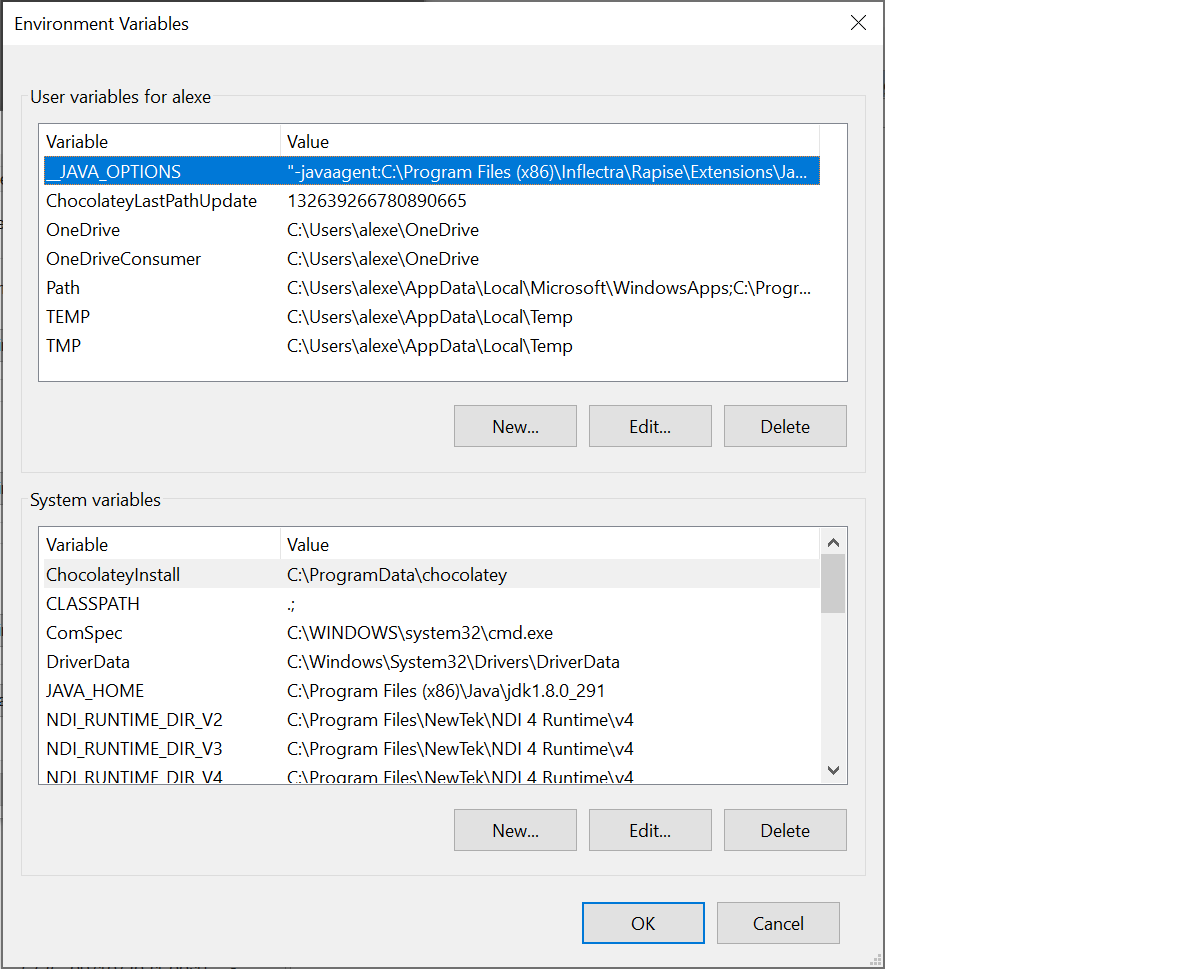
It can be set through system or user environment variables. Alternatively, if your application is launched from a .bat file, you can set _JAVA_OPTIONS there:
...
set _JAVA_OPTIONS=-Dsun.java2d.dpiaware=true -Dsun.java2d.uiScale=1.0 -javaagent:C:\PROGRA~2\Inflectra\Rapise\Extensions\JavaWrapper\Agents\PreMainAgent.jar
-Djava.security.policy=C:\PROGRA~2\Inflectra\Rapise\Extensions\JavaWrapper\Agents\file.policy -Djavax.accessibility.assistive_technologies=com.smartesoft.smartestudio.accessibility.AccessBridge
...
rem <launch of the application.jar>
Setting _JAVA_OPTIONS globally may affect other software or tools. Therefore, if you encounter any problems, you can remove this variable or rename it to another name.
Launching Oracle Forms Application
There are two major ways your application can be started: using Internet Explorer or Java Web Start (.jnlp file).
Configure EBS as Administrator
Login as SYSADMIN.
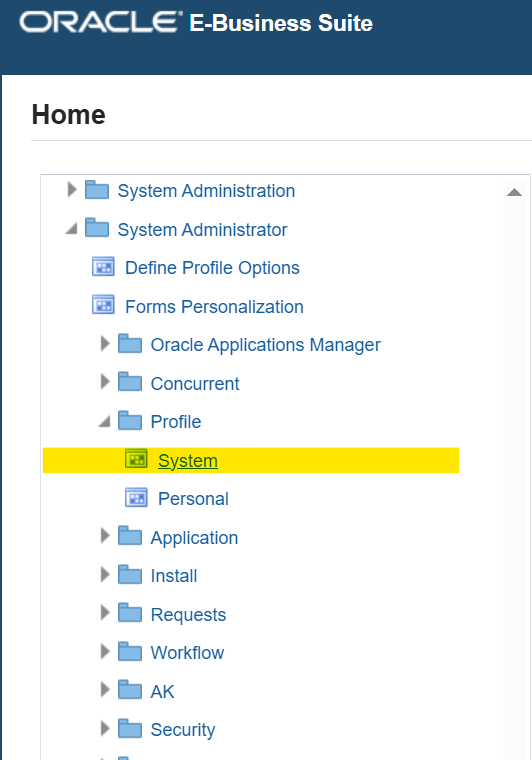
Step 1: Open the System Profile Window
- On the left menu, under System Administrator, look inside the Profile folder.
- Click on
System.
(This will download/launch the Forms window).
Step 2: Search for the User and Profile
In the Find System Profile Values popup window:
- Check the User checkbox and type the target User Name.
- In the Profile field, enter:
ICX: Forms Launcher%
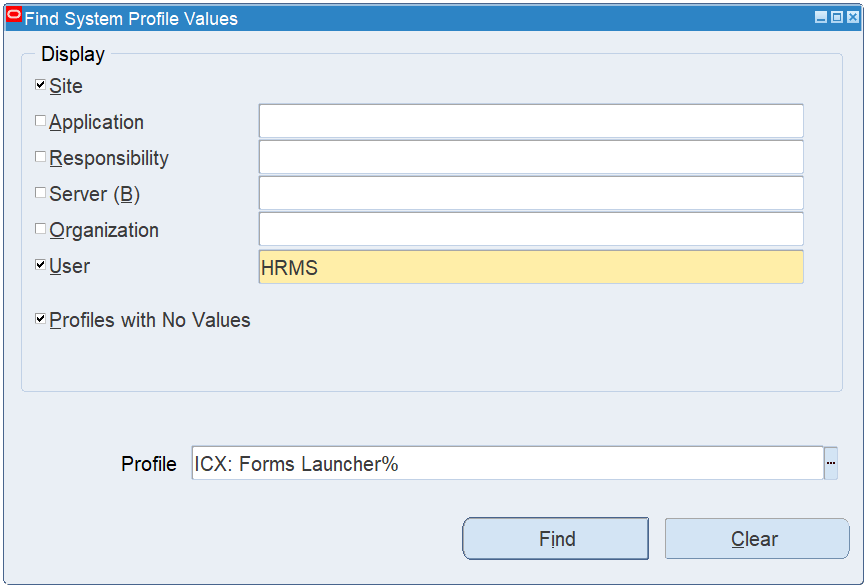 3. Click the Find button.
Step 3: Add &record=names to the User Level
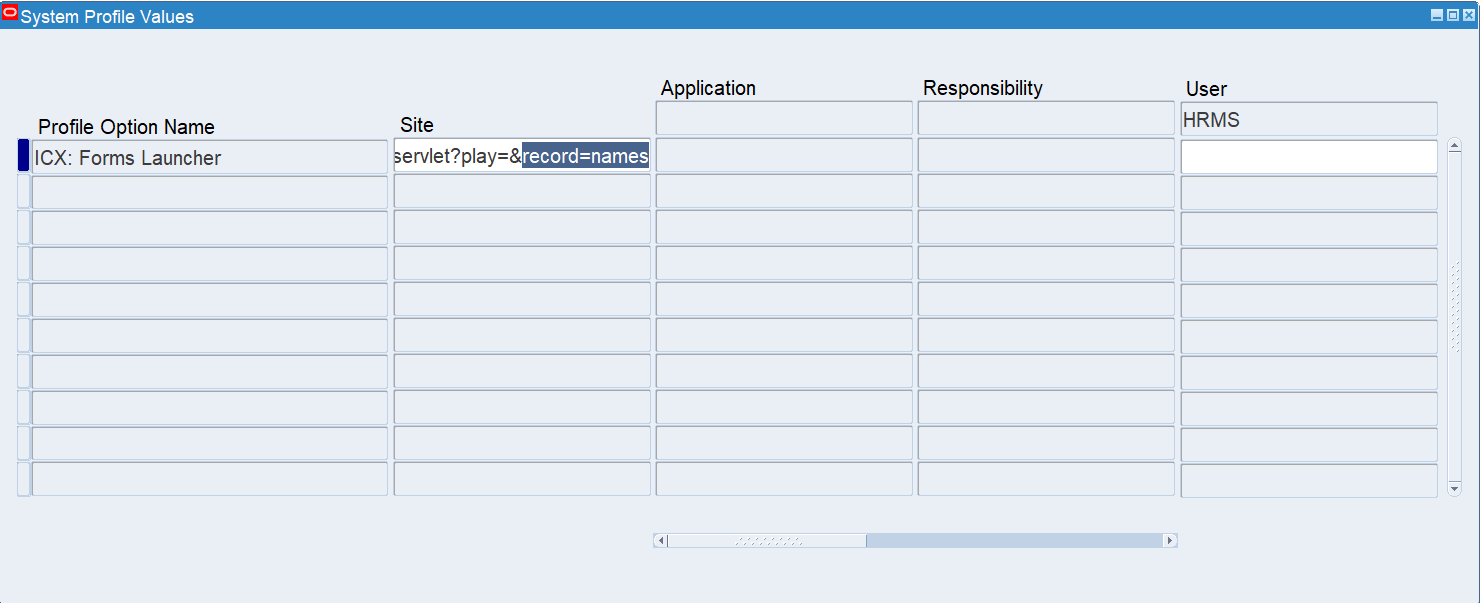
In the System Profile Values table:
- Look at the existing URL under the Site column (e.g.,
http://hostname:port/forms/frmservlet). - Copy that exact URL and paste it into the User column.
- Append
record=namesto the end:
-
If the Site URL has no
?, add:?record=names -
If the Site URL already contains a
?, add:&record=names -
Click the Disk/Save icon in the top toolbar (or press
Ctrl + S).
⚠️ Note (If the User field is greyed out / read-only):
If the system does not let you edit the User column:
- Go back to your menu and click
Define Profile Options(located right under System Administrator). - Query
ICX_FORMS_LAUNCHER. - Under the User Access section, ensure the User checkboxes for Visible and Updatable are checked, then click Save.
- Return to Profile > System and set the URL.
Configure Individual Forms or .jnlp files
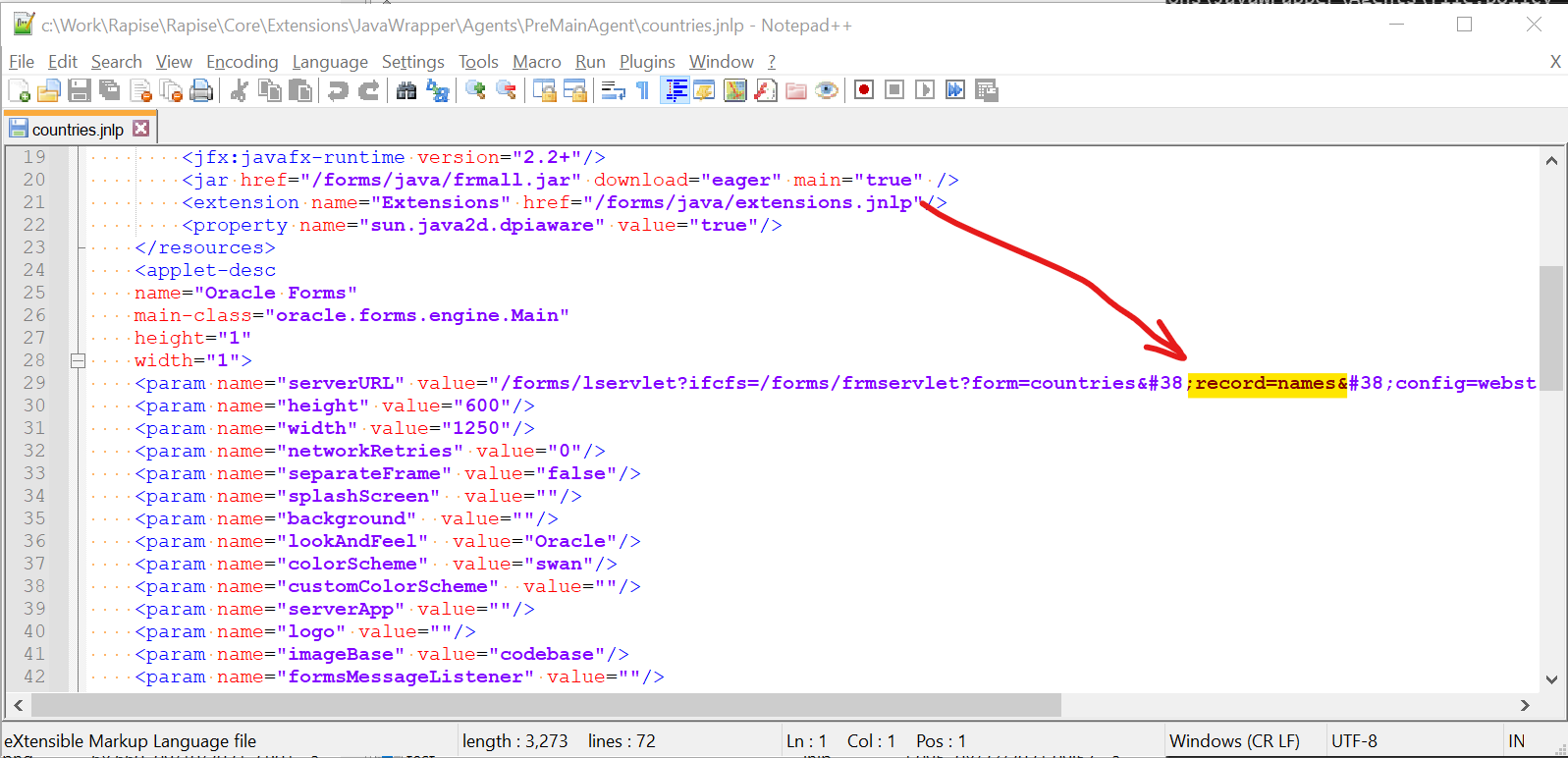
In either case, you need to make sure that the application URL contains the following parameters:
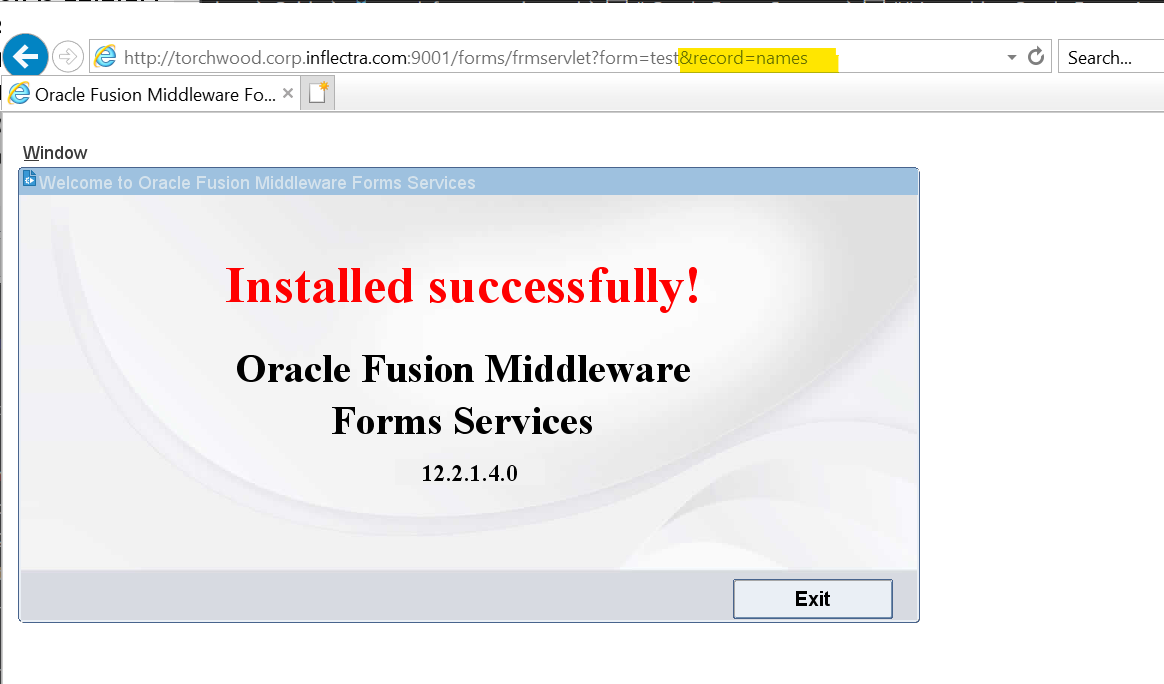
From Internet Explorer
You need to append the following parameter to the URL:
...&record=names
For Internet Explorer, this means the URL must contain this part:
From Java Web Start .jnlp File
...&record=names
Global Object
Rapise Oracle Forms Library includes the OracleForms global object. It is mostly used to deal with the main menu, notifications, and status bar.