Command Line
Purpose
Rapise test scripts can be run from the command line. This is useful for integrating Rapise into CI/CD pipelines, scheduling automated test runs, or running tests without opening the Rapise IDE.
Usage
Using play.bat
The simplest way to run a single test directly is:
"C:\Program Files (x86)\Inflectra\Rapise\Engine\play.bat" <path_to_sstest_file>
If you want to pass additional parameters as JSON, then:
"C:\Program Files (x86)\Inflectra\Rapise\Engine\play.bat" <path_to_sstest_file> -config:LastConfig.json.user
In this case, the LastConfig.json.user file, stored in the framework root, contains values from the last execution by Rapise itself. It includes framework parameter values, such as:
{
  "Browser": "Selenium - Chrome",
  "Mode": "Staging"
}
You may customize this JSON file and specify it, for example:
"C:\Program Files (x86)\Inflectra\Rapise\Engine\play.bat" <path_to_sstest_file> -config:CustomParams.json
It is also possible to specify a test case folder rather than a Test.sstest file, for example:
"C:\Program Files (x86)\Inflectra\Rapise\Engine\play.bat" "TestCases\Author Management\Create New Author" -config:LastConfig.json.user
Using SeSExecutor.js
SeSExecutor is a more powerful command-line tool that can run individual tests, test sets defined in JSON files, or framework-level test sets. It provides detailed execution reports and supports integration with CI/CD systems through JUnit XML output.
Basic Syntax
%windir%\syswow64\cscript.exe "C:\Program Files (x86)\Inflectra\Rapise\Engine\SeSExecutor.js" <path> [options]
Where <path> can be:
- Path to a
.sstestfile (runs a single test) - Path to a
.jsontest set file (runs multiple tests) - Path to a framework folder (when using
-testset:parameter)
Command Line Options
| Option | Description |
|---|---|
-config:<path> |
Path to a JSON configuration file containing parameter values |
-testset:<name> |
Name of a test set defined in the framework's Framework.json (added in Rapise 9.1) |
-report:<path> |
Path for JUnit XML report output (added in Rapise 9.1) |
-eval:<statements> |
JavaScript statements to execute before the test (e.g., -eval:g_verboseLevel=2) |
Running a Single Test
cscript.exe "C:\Program Files (x86)\Inflectra\Rapise\Engine\SeSExecutor.js" "C:\Tests\MyTest\Test.sstest"
With parameters:
cscript.exe "C:\Program Files (x86)\Inflectra\Rapise\Engine\SeSExecutor.js" "C:\Tests\MyTest\Test.sstest" -config:params.json
Running a Test Set from JSON File
Create a test set definition file (e.g., regression.json):
{
    "name": "Regression Tests",
    "description": "Full regression test suite",
    "verboseLevel": 1,
    "stopOnError": false,
    "_": [
        "TestCases/Login/Test.sstest",
        "TestCases/Search/Test.sstest",
        {
            "path": "TestCases/Checkout/Test.sstest",
            "params": { "PaymentMethod": "CreditCard" }
        }
    ]
}
Run the test set:
cscript.exe "C:\Program Files (x86)\Inflectra\Rapise\Engine\SeSExecutor.js" "C:\Tests\regression.json"
Running a Framework Test Set
Added in Rapise 9.1
Run a test set defined in your framework's Framework.json:
cscript.exe "C:\Program Files (x86)\Inflectra\Rapise\Engine\SeSExecutor.js" "C:\MyFramework\Framework.sstest" -testset:"Smoke Tests"
This reads the test set configuration from Lib/LibFramework/Framework.json and applies parameter values from Lib/LibFramework/Parameters.json.
Warning
Dynamic test sets (those using filters) are not supported in command-line mode.
JUnit XML Report Output
Added in Rapise 9.1
Generate JUnit XML reports for CI/CD integration:
cscript.exe "C:\Program Files (x86)\Inflectra\Rapise\Engine\SeSExecutor.js" "C:\Tests\regression.json" -report:results.xml
The JUnit XML output includes:
- Test suite name and statistics (total, failures, errors, skipped)
- Individual test case results with execution time
- Failure messages extracted from Rapise
.trpreport files - Compatible with Jenkins, Azure DevOps, GitLab CI, and other CI/CD tools
Example output:
<?xml version="1.0" encoding="UTF-8"?>
<testsuites>
  <testsuite name="Regression Tests" tests="3" failures="1" errors="0" skipped="0" time="45.230">
    <testcase name="Login" time="12.450"/>
    <testcase name="Search" time="8.320"/>
    <testcase name="Checkout" time="24.460">
      <failure message="Assert: Payment validation failed">
        <![CDATA[Log Entry: Verify Payment
Type: Assert
Status: Fail
Expected credit card acceptance]]>
      </failure>
    </testcase>
  </testsuite>
</testsuites>
Disabling Self-Healing
Added in Rapise 9.1
To disable AI-powered self-healing during automated execution, set the g_saDisableHealing global variable:
cscript.exe "C:\Program Files (x86)\Inflectra\Rapise\Engine\SeSExecutor.js" "C:\Tests\Test.sstest" -eval:g_saDisableHealing=true
Or include it in your config JSON file:
{
    "g_saDisableHealing": true
}
This is useful when running tests in CI/CD pipelines where you want consistent behavior and don't want tests to automatically adapt to UI changes.
Global Variables
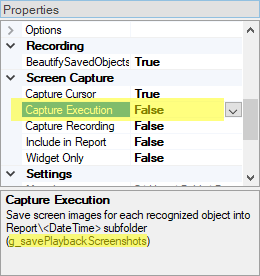
You can set global variables using the -eval: option. Global variables are prefixed with g_. The global variables under the Execution and Recording headings can be found by clicking on the corresponding option in the Settings Dialog:
Commonly used variables include:
| Variable | Description |
|---|---|
g_verboseLevel |
Logging verbosity (0-4, default: 1) |
g_enablePopupMessages |
Enable/disable popup messages (default: false in SeSExecutor) |
g_saDisableHealing |
Disable AI self-healing (default: false) |
g_saForceHealing |
Force AI self-healing for all objects (default: false) |
Exit Codes
| Code | Meaning |
|---|---|
| 0 | Test passed |
| 1 | Test failed |
| -1 | Execution error (e.g., test not found, configuration error) |
Test Set JSON Structure
A test set JSON file supports the following properties:
| Property | Type | Description |
|---|---|---|
name |
string | Display name for the test set |
description |
string | Optional description |
verboseLevel |
number | Logging level (0-4) |
stopOnError |
boolean | Stop execution after first failure |
testCount |
number | Limit number of tests to run (-1 for all) |
reportFileName |
string | Custom name for the .trp report file |
globals |
object | Global variables passed to all tests |
config |
object/string | Configuration object or path to config file |
_ |
array | List of test paths or test objects |
Test entries in the _ array can be:
- Simple string paths:
"TestCases/Login/Test.sstest" - Objects with parameters:
{
    "path": "TestCases/Login/Test.sstest",
    "name": "Login Test",
    "params": { "Username": "admin" },
    "expected": "PASS",
    "comment": "Tests admin login"
}
See Also
- Settings Dialog
- Test Framework Parameters
- Web Self-Healing
- KB17 Running a Rapise script from the command-line on a 64-bit machine